|
![[Ports]](../images/48x48/port.gif)
|
![[Open sourced REBOL 3 programming language on Syllable Desktop 0.6.7]](http://web.syllable.org/images/screenshots/Desktop/0.6.7/Open-source-REBOL-3-on-SyllableDesktop-200x150.jpg)
As we predicted many years ago, version 3 of the REBOL programming language has finally been open sourced, under the Apache 2 licence. REBOL originally constituted our main cross-platform strategy, but we are now also free to use it in the Syllable base platform, which should not contain closed parts.
So far, REBOL 3 ran on Syllable Desktop using the Linux version of the interpreter library. Now its source code compiles natively on Syllable, and we have integrated it in our build system. To compile REBOL and start it, enter the following commands in the terminal. You need the latest version of Builder. On Syllable Desktop 0.6.7, do:
    build update
    build log
    package unregister Builder
    package register Builder
    build REBOL-Core--current
    build install REBOL-Core--current
    r3
On Syllable Server, install the newer Builder package. Then do:
    s build update
    build log
    build get REBOL-Core--current
Install the binary version of REBOL 3 in the REBOL-Core--current/make/ subdirectory as r3-make. Then from the parent directory again:
    build REBOL-Core--current
    build install REBOL-Core--current
    r3
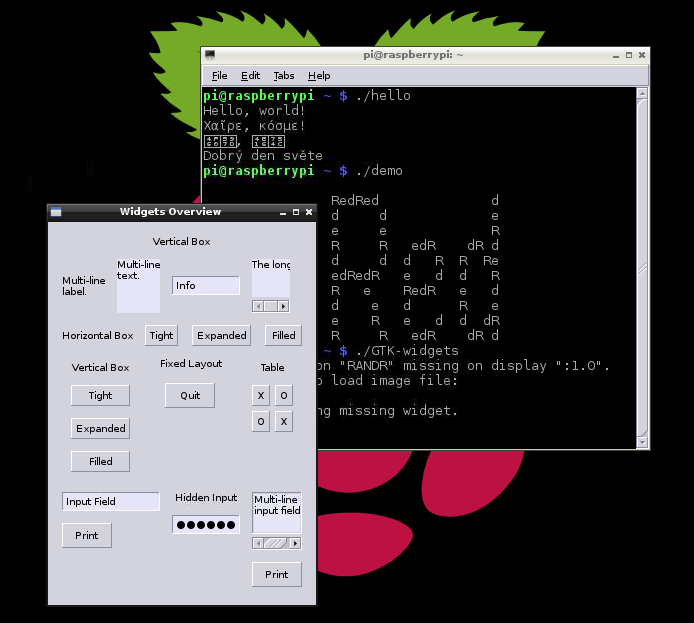
We now have the choice between the interpreted REBOL language and the compiled Red language. We have already contributed a bridge between them, that allows to write REBOL extensions in the Red/System language. Previously, REBOL 3 extensions needed to be developed in C, which has proven unpopular. This currently requires a development branch of Red on Windows, but this will be extended to Syllable.
|
|
![[News]](../images/64x64/announce.gif)
|
We were recently asked to do an interview for IDG. The article is now published as the top story on TechWorld Australia. There is a summary article, written by Rohan Pearce. We congratulate Rohan on his new position as the editor of TechWorld. He was kind enough to publish the full interview, as well. The articles are even discussed on Slashdot.
|
|
|
|
The website for the ReBorCon 2011 that Bas is organising is now available. ReBorCon is a new, international conference for the REBOL family of programming languages, including the current REBOL 2 line, the REBOL 3 in development, and the open source Boron language. The programme includes several topics that are of interest for Syllable.
|
|
|
|
![[Syllable Server with Rox Desktop]](http://nl.syllable.org/2010/SummerSylCon/Syllable-Server-Rox-Desktop.jpg)
During the SylCon Summer conference 2010 we filmed the presentations given. It took a while to process them, but thanks to skûtsje shipper Paul Fortuijn (who took the time of processing all the movies) now they are finally available on YouTube. If you want to view the movies in Ogg video format, use this website: TinyOgg.com.
Topics covered include the Syllable Server release 0.4, the new graphical development version of Syllable Server, advancements in REBOL 3, improvements in our CMS and how we will open up our communication channels. The movies are Dutch spoken. If you want to help making translations and sub-titles of these videos please contact Bas de Lange on the email address mentioned here.
|
|
|
|
We wish everyone a good Syllable year! Last year we promised to create some breakthroughs, and we did. After making the REBOL 3 and Boron programming languages available on both Syllable Desktop and Syllable Server, we started working on their closer integration with the system. We created the first REBOL extension on Syllable, and will soon announce the first binding with a programming library. We made the REBOL 3 collaboration system and the CMS for the Syllable web sites run on Desktop. The CMS became more capable and fifteen times faster, so that it is now much easier for us to maintain the sites. We made a new Syllable Server release, and created a graphical version of it with the ROX desktop, that we are using internally and that has enabled us to move away from non-Syllable Linux distributions (extending our hardware's life span in the process).
Most of these accomplishments are "under the hood". We demonstrated them on the Syllable Conferences and on Software Freedom Day, but they are not easily available yet. So the main goal for this year is to continue with these developments and to make them better available to the public.
|
|
![[Applications]](../images/64x64/applications.gif)
|
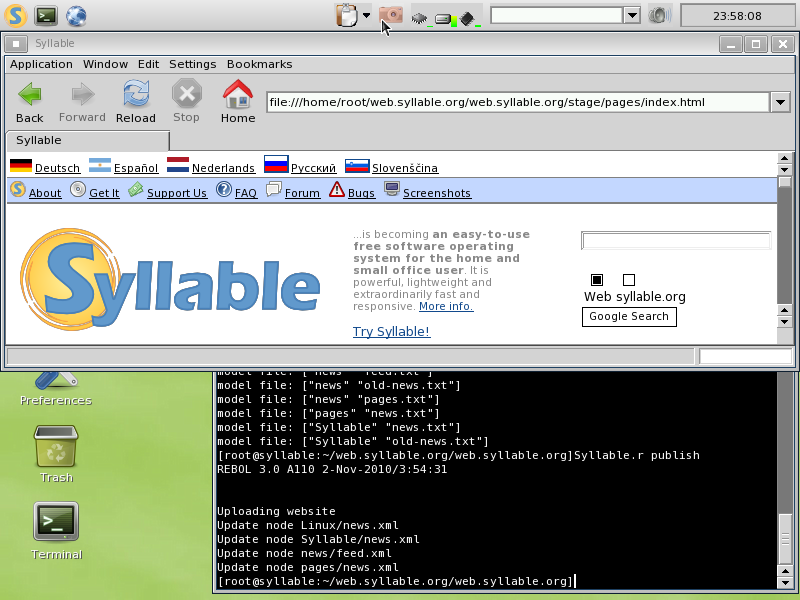
![[Syllable Desktop building and publishing its own website]](http://web.syllable.org/images/screenshots/Desktop/0.6.7/SyllableDesktop-building-own-website-200x150.png)
The CMS that builds our websites was used on Syllable Server so far, but now it has been ported to Syllable Desktop. This was done by porting it to REBOL 3. The screenshot shows Desktop building its own website in static batch mode and synchronising it with Amazon S3.
 This screenshot shows Webster previewing the built site as local files. Building the websites on Syllable Server is around 35% faster with REBOL 3 than with REBOL 2. A few longstanding problems in our Russian website and documentation were fixed because REBOL 3 now understands Unicode. This screenshot shows Webster previewing the built site as local files. Building the websites on Syllable Server is around 35% faster with REBOL 3 than with REBOL 2. A few longstanding problems in our Russian website and documentation were fixed because REBOL 3 now understands Unicode.
|
|
|
|
Bas is organising a conference for the REBOL family of programming languages, including the current REBOL 2 line, the REBOL 3 in development, and the open source Boron language. The conference will be held on Saturday February 26 in the Netherlands, in the same venue as the Syllable conferences. Many of the demonstrations will be done on Syllable Server and Syllable Desktop.
We will set up a website for the conference later, but we want to get the word out as soon as possible to gauge interest. If we get international visitors, we have the option to scale up the event to multiple days, including the Friday, to make the journey worth their while. So if you are contemplating coming, or even better if you are interested to give a presentation or demonstration or workshop, please contact Bas de Lange.
Update:
The website is now on-line.
|
|
|
|
![[Boron programming language]](http://web.syllable.org/images/Boron-logo.jpg)
Kaj has overhauled the Boron demonstration he presented at Software Freedom Day for publication on the web. Boron is the programming language that is the successor to the ORCA language that we use in Syllable. If you want to try it, Boron is already available in Syllable Server 0.4 and the development build of Syllable Desktop.
The presentation starts with an introduction to Boron. It then demonstrates how to build a small dynamic website that serves up the presentation itself. So there is a simple website content management system in there and a simple presentation program, in about fourty lines of Boron programming. Both the program and the presentation are available for download.
The demonstration is running on Syllable Server and the Cheyenne web server, just like the original talk at Software Freedom Day. It could also run on Syllable Desktop by using one of the web servers available for Desktop.
|
|
|
![[Screenshot]](http://web.syllable.org/images/screenshots/Server/0.1/Server-0.1-on-Desktop-0.6.4-200x150.jpg)
Syllable Server emulated on Syllable Desktop
 More
Screenshots More
Screenshots
![[Newsletter]](http://web.syllable.org/magazines/SDN/2007/2/SDN-2007-2-180x251.jpg)
 Read
Newsletter #2 Read
Newsletter #2
|
 Deutsch
  Español
  Nederlands
  Русский
  Slovenščina
![[Syllable Logo]](../images/Syllable-logo.png)

![[Screenshot]](http://web.syllable.org/images/screenshots/Server/0.1/Server-0.1-on-Desktop-0.6.4.png)
![[Newsletter]](http://web.syllable.org/magazines/SDN/2007/2/SDN-2007-2.png)


![[Open sourced REBOL 3 programming language on Syllable Desktop 0.6.7]](http://web.syllable.org/images/screenshots/Desktop/0.6.7/Open-source-REBOL-3-on-SyllableDesktop.png)
![[Red programming language alpha 1 on Syllable Desktop 0.6.7]](http://web.syllable.org/images/screenshots/Desktop/0.6.7/Red-alpha-1-on-SyllableDesktop-0.6.7.png)
![[Syllable Desktop showing multiple open filer windows]](http://nl.syllable.org/2010/SummerSylCon/Syllable-Desktop-filers.jpg)
![[Syllable Desktop building and publishing its own website]](http://web.syllable.org/images/screenshots/Desktop/0.6.7/SyllableDesktop-building-own-website.png)